


Campaign websites are often treated like digital brochures. A place to host a donation button, list issues, and drop in a standard biography. But new research from the Center for Campaign Innovation suggests something campaign professionals should not ignore:
Your website biography correlates with electoral performance in measurable ways tied to length, structure, and narrative discipline. Here’s what the data tells us about how to write an effective campaign bio.
Not Too Short, Not Too Long
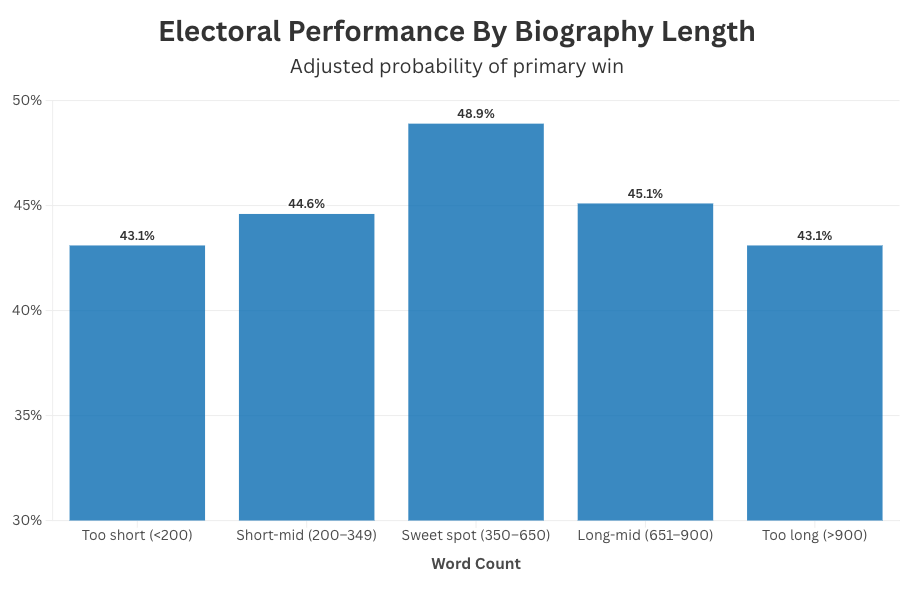
The research finds that biographies in roughly the 350–650 word range correlate most consistently with stronger electoral outcomes. Campaigns that fall well below that range often look unserious. Campaigns that exceed it tend to ramble, dilute their message, or overwhelm the reader.
Aim for tight, intentional, and substantive.
Easy To Read, But Not Too Easy
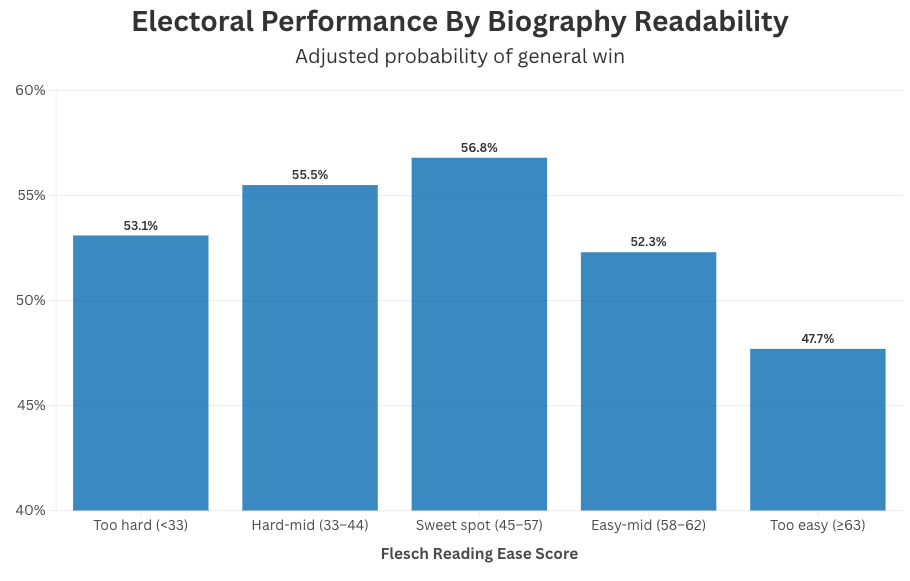
Flesch Reading Ease is a score calculated to measure the readability of a piece of text. The research found that bios with a score between 45-57 align with another sweet spot in electoral performance. You can use an LLM like ChatGPT to help you calculate your Flesch Reading Ease score and change your bio accordingly.
Generic Loses
Bios that rely heavily on slogan-like phrasing and template language tend to blur together. When voters encounter interchangeable biographies, credibility weakens.
Strong bios are plainspoken but substantive. They communicate depth without sounding academic or hollow.
Narrative Beats Resume
Many campaign biographies read like LinkedIn pages. They list degrees, job titles, and committee assignments in chronological order.
High-performing biographies feel different. They explain how experiences shaped the candidate and why those experiences led them to run.
Third Person, Not First
Authenticity matters, but over-reliance on first-person framing does not necessarily signal strength. Once structural advantages like incumbency are accounted for, professionally framed narrative voice tends to correlate more favorably.
A biography that reads like a prepared profile often signals seriousness. A biography that reads like a speech draft can feel reactive or overly self-focused.
Specificity Signals Competence
Nearly every campaign biography is positive. Tone alone does not differentiate performance. What does differentiate is distinctiveness. Concrete details about service, leadership, business ownership, or community involvement make candidates easier to remember.
Include specific facts and details.
Conclusion
Your campaign biography is credibility infrastructure. It signals seriousness, discipline, and narrative coherence before a voter hears a speech or sees an ad.
Campaigns that stay disciplined in length, clear in prose, narrative in structure, and specific in detail gain an early perception advantage. In close races, those small advantages compound.