


Advertising
An ad blocker for political ads? One study tried it.
Yello
“While much of digital campaign advertising is fundraising, researchers said seeing political ads over the study period didn’t increase donations by more than $2.50 per person, nor did it increase the probability of someone making a campaign contribution. The effects on contributions weren’t zero, but they also weren't much, and the study’s authors say it suggests that people who donate make contributions, just not through donation ads.”
Secure AI ToolKit for Campaigns
Getting started with AI for your campaign? Start securely.
A practical, security‑first guide to understanding AI risks, setting guardrails, and adopting AI responsibly from the start. Built by Defending Digital Campaigns and Microsoft.
Campaigns
One Text After the Knock: The Simple Add-On That Boosts Voter Turnout
Center for Campaign Innovation
“Across both phases of the experiment, voters who received one text message after the canvass attempt turned out at higher rates than those who were only canvassed. The effect was modest — about 1.8 points overall — but in competitive races, that kind of movement changes outcomes.”
The organizing model that failed the Democrats
Chaotic Era
“People don’t answer their phones anymore: in 2024, Democrats made 300 million phone call attempts, with only a 3% contact rate. (That number fell to 2% across Democratic campaigns in 2025.)”
Content
Where do Americans look first for breaking news information?
Pew Research Center
“By contrast, younger adults are more likely to say they turn to search engines and social media for breaking news. For example, 31% of adults under 30 say they turn to social media first to get more information about breaking news events. Just 6% of Americans 65 and older say the same.”
Fundraising
Entrepreneurs of conflict: A descriptive analysis of when and how political elites use divisive rhetoric
PNAS Nexus
“We find no fundraising advantage associated with focusing on critical policy debate, nor is there a penalty for those who engage in personal attacks (Fig. 4B). Legislators who personally attack fellow politicians raise neither more nor less money than their more civil counterparts. This null relationship holds for both in-state and out-of-state donations.”
Social Media
Influencer Group That Boosts Democrats Faces House Investigation Over ‘Dark Money’ Ties
Free Press
“A nonprofit group that works with popular Democratic political influencers is under investigation by the House Oversight Committee for “a disturbing pattern of activity” possibly intended to evade campaign finance disclosure rules.”
For Republicans, the political influence of X is greater than ever
Chaotic Era
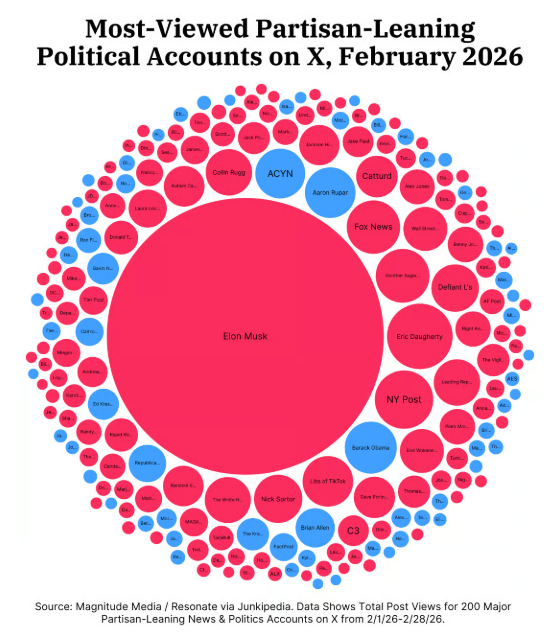
“According to data from Magnitude Media, Right-leaning accounts regularly receive far more post views than their liberal counterparts. Out of the top 100 most-viewed X accounts posting about politics in February 2026, 74 were conservative-leaning and 26 were liberal-leaning.”
Technology
Introducing Aide: The AI Development Engine for Public Affairs and Politics
GP3 Tech
“Bullpen Strategy Group has unlocked the equivalent of 17.5 FTEs of capacity from the platform, reallocating 700+ staff-hours per week from assembly to analysis.”
iOS 26 Didn’t Kill Political Calls or Texts
CampaignHQ
“Across recent programs, live calls continue to reach voters at strong rates:
- 75% penetration (connect rate) for live calls to cell phones with voicemail
- 35% penetration (connect rate) for live calls cell phones without voicemail
Those numbers are consistent with pre-iOS 26 performance, reinforcing that call reach has not been meaningfully impacted.”